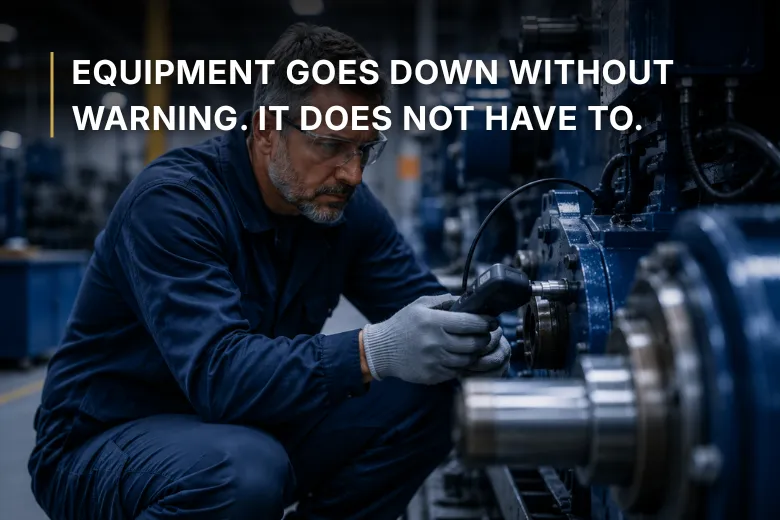
Equipment Goes Down Without Warning. It Does Not Have To.
Every manufacturing and fabrication business we work with has a version of the same story.
The equipment was running fine. Then it was not. And by the time anyone knew there was a problem, production was already stopped, the schedule was already disrupted, and the cost was already climbing.
Most equipment does not fail without warning. It runs differently in the hours and days before a breakdown. The pattern is there. The data is being generated. Nobody is reading it.
That is what predictive maintenance fixes. And it is one of the highest-ROI first implementations we run for manufacturing clients in Western Canada.
What Predictive Maintenance Actually Does
Predictive maintenance is not a monitoring dashboard someone checks periodically. It is an AI system that reads your equipment data continuously and alerts your team when something needs attention before it becomes a breakdown.
The system learns what normal looks like for each piece of equipment in your specific operation. It identifies the patterns that precede failures. And it surfaces those patterns early enough for your maintenance team to act.
The result is not zero breakdowns. It is breakdowns that happen on your schedule, not your equipment's schedule.
What the Data Looks Like
Most manufacturing and fabrication businesses are already generating the data predictive maintenance needs. Vibration. Temperature. Power consumption. Cycle time. Runtime hours. The sensors are often already there.
The problem is not that the data does not exist. It is that nobody is reading across it in real time, connecting the patterns, and surfacing what matters.
Predictive maintenance connects to your existing equipment data, adds sensors where they are missing, and builds the AI layer that reads it continuously.
What Changes
The most immediate change is unplanned downtime. When your maintenance team is responding to alerts instead of reacting to failures, the work gets done during scheduled windows rather than emergency stops.
The downstream changes compound. Production schedules become more reliable. Asset life extends because issues are caught early. Maintenance costs shift from reactive to planned, which is almost always less expensive.
A Regina manufacturing client we worked with identified the pattern that preceded their most common failure mode within the first 60 days of implementation. The same failure had been occurring every four to six weeks for two years.
What It Takes to Get Started
Predictive maintenance starts with understanding your current equipment environment. What data is being generated. What sensors are in place. What failure modes cost you the most.
The 3-Day Business Audit maps this as part of your broader technology and AI readiness assessment. You walk away knowing exactly which equipment is worth prioritizing, what data infrastructure is already in place, and what your first implementation should target.
No cost. No obligation. No commitment to anything beyond the conversation.
Book Free Audit