
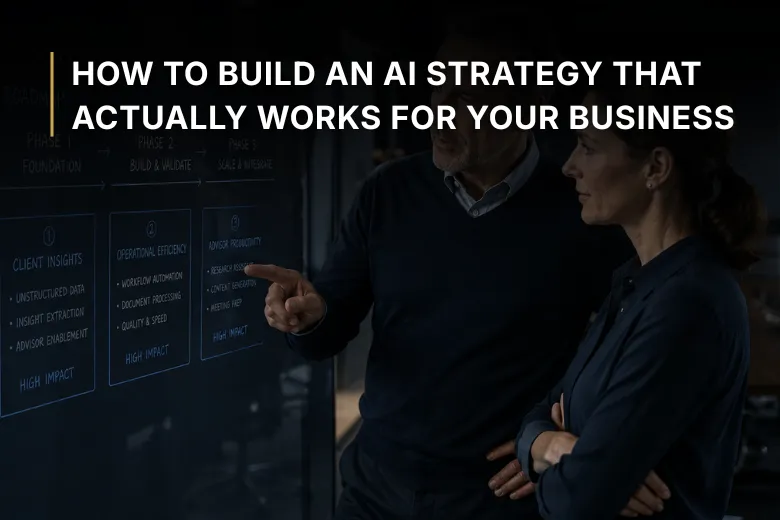
How to Build an AI Strategy That Actually Works for Your Business
Most AI strategies we see have the same problem.
They start with the technology. Which AI platforms are available. What capabilities exist. What competitors are doing.
The businesses that get real results from AI start somewhere else entirely. They start with the business. What decisions need to be made faster. What processes are consuming the most cost. What operational problems have the clearest data trail.
That difference in starting point determines everything that follows.
Why Most AI Strategies Underperform
An AI strategy built around available technology tends to produce a list of interesting possibilities with no clear prioritization. Everything sounds promising. Nothing is specific enough to commit to.
When implementation starts, scope creep is immediate. Every stakeholder sees a different application. The project loses focus. Timelines stretch. Budgets expand. Results take longer to materialize than expected.
By the time the organization is questioning whether the investment was worth it, the original problem it was supposed to solve has been buried under layers of scope that were added along the way.
A Business-First AI Strategy
A business-first AI strategy starts by answering three questions before any technology is discussed.
What are the three to five most costly operational problems in the business right now?
Cost can be measured in time, errors, margin, or missed opportunity. The goal is to identify the problems where solving them would have the clearest, most measurable impact.
What data exists around each of these problems?
AI requires data. Before committing to an AI solution for a specific problem, you need to know whether the data that would train and run that solution actually exists in your operation and in what state.
What does success look like in specific, measurable terms?
Not better job costing but job costing that reduces over-budget projects by 20 percent within 90 days. The specificity of the success metric determines how clearly you can evaluate whether the AI is delivering.
Answering these three questions produces a clear, prioritized list of AI opportunities ranked by business impact and data readiness. That list is the foundation of an AI strategy that works.
Phasing the Strategy
Not every AI opportunity gets pursued at once. A good AI strategy is phased based on two criteria.
Impact and readiness. High-impact opportunities where the data and foundation are already in place go first. They deliver results quickly and build organizational confidence in AI as a real investment.
Foundation requirements. Opportunities that require significant foundation work before AI can be deployed go into a second phase, alongside the foundation work that makes them possible.
This phasing ensures you are always building toward a more capable operation rather than pursuing every opportunity simultaneously and executing none of them well.
The Role of the AI Strategy and Roadmap Service
ICG's AI Strategy and Roadmap service produces a phased, prioritized plan for your AI implementation aligned specifically to your business goals.
It covers:
Which use cases to pursue and in what order
What foundation work is required before each phase
What success looks like for each implementation
How each phase builds toward a fully intelligent operation over time
The resource and investment requirements for each phase
The roadmap is not a vendor pitch. It is not a technology catalog. It is a business plan for your AI investment built around what your specific operation needs and is ready for.
Starting Point
The 3-Day Business Audit is the natural starting point for building an AI strategy. The audit maps your current state across all eight dimensions of the IN.8 Framework and produces the prioritized recommendations that form the foundation of your roadmap.
You can take those recommendations and build your strategy independently, or work with us to develop and execute it.
Book Free Audit