
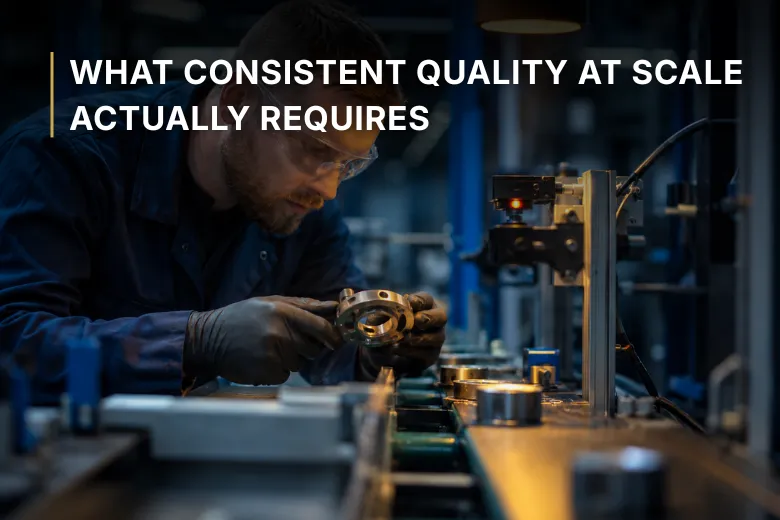
What Consistent Quality at Scale Actually Requires
Consistent quality is one of the hardest things to maintain as a manufacturing or food production business grows.
At small scale, quality depends on a few experienced people who know the standard and apply it consistently. That works until the operation scales, shifts change, people move on, and the knowledge that maintained the standard becomes unevenly distributed.
The question is not whether your people care about quality. They do. The question is whether your systems can maintain consistency independently of who is on shift.
Why Manual Inspection Breaks Down at Scale
Manual quality inspection is inherently variable. It depends on the experience and attention of the inspector, how clearly the standard has been communicated, how many hours into the shift the inspection is happening, and how many other things the inspector is managing simultaneously.
None of these variables disappear with training. They are human factors. And they mean that the same product inspected by two different people at two different points in a shift can produce two different outcomes.
At small scale this variability is manageable. At large scale it becomes the source of defects that get through, rework that consumes capacity, and customer complaints that damage relationships.
What AI Quality Monitoring Does Differently
AI-powered quality monitoring does not replace human inspection. It provides a consistent, continuous layer of monitoring that does not vary based on who is doing it or when.
The system monitors the parameters that indicate quality in your specific operation. For manufacturing businesses this might be dimensions, surface finish, weight, or assembly consistency. For food production businesses it might be temperature, weight, appearance, or moisture content.
When a parameter falls outside the acceptable range, the system flags it immediately. Not at the end of the batch. Not when someone runs the daily quality report. In real time, while the production process is still running and the issue can still be addressed.
The outcome is defects caught before they become rework or customer returns. Product consistency that does not depend on which crew is working. And a quality record that is built continuously rather than assembled manually.
The Cost of Getting It Wrong
The cost of a quality failure is rarely just the cost of the defective product.
Rework consumes production capacity that should have been used on new work. Customer complaints require management time to address. Returns create logistics costs and inventory disruption. And in food production, a quality failure can trigger a compliance review that is expensive regardless of the outcome.
AI quality monitoring does not eliminate the possibility of a quality issue. It reduces the window between when a deviation occurs and when it is caught, which is where most of the cost lives.
Starting Point
Quality control automation is one of the implementations the Business Audit identifies most frequently for manufacturing and food production businesses. The data required to build the monitoring system is usually already being generated by your production equipment. It just has not been connected to a system that reads it continuously.
The audit maps your current quality processes, identifies where AI monitoring would deliver the most immediate impact, and tells you what your first implementation should target.
Book Free Audit